Welcome to Computational Engineering Laboratory web site

Faculty of Engineering, University of Rijeka

3rd Computational Engineering Seminar

We are happy to announce yet antoher seminar at our lab.

The seminar will take place on Tuesday, April 28, at 1:30 PM, as usual in room L10 (Computational Engineering Laboratory).

Presentations:

  • Martina Ivić: Wind farm layout optimization
  • Stefan Ivić: IndagoBench25 meta-optimization for determining best default parameters of optimization methods
  • Siniša Družeta and Stefan Ivić: Support for integer, discrete, categorical, and periodic optimization variables in new Indago API

All interested researchers and students are warmly invited to attend. We look forward to your participation!

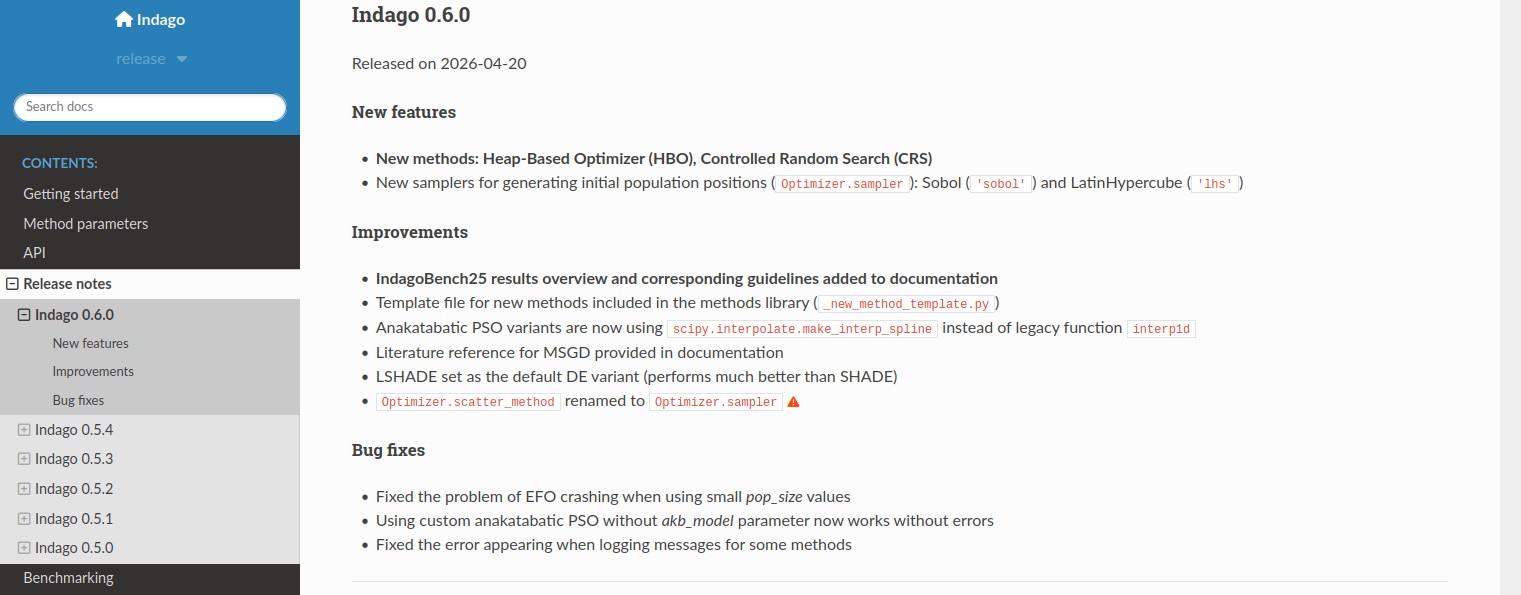
Indago 0.6.0 released

We are happy to announce the new release of Indago!

Check the PyPI for installation (https://pypi.org/project/Indago) and the documentation (https://indago.readthedocs.io/index.html)

New features

  • New methods: Heap-Based Optimizer (HBO), Controlled Random Search (CRS)
  • New samplers for generating initial population positions (Optimizer.sampler): Sobol (‘sobol’) and LatinHypercube (’lhs’)

Improvements

  • IndagoBench25 results overview and corresponding guidelines added to documentation
  • Template file for new methods included in the methods library (_new_method_template.py)
  • Anakatabatic PSO variants are now using scipy.interpolate.make_interp_spline instead of legacy function interp1d
  • Literature reference for MSGD provided in documentation
  • LSHADE set as the default DE variant (performs much better than SHADE)
  • Optimizer.scatter_method renamed to Optimizer.sampler

Bug fixes

  • Fixed the problem of EFO crashing when using small pop_size values
  • Using custom anakatabatic PSO without akb_model parameter now works without errors
  • Fixed the error appearing when logging messages for some methods

Lecture: Autonomous UAV system for oceanic search and rescue

We invite you to a lecture: “Autonomous UAV system for oceanic search and rescue

Prof. Stefan Ivić, PhD, head of the research project funded by the Croatian Science Foundation titled “Autonomous UAV system for oceanic search and rescue” (AOSeR), will present the project results, including an overview of its implementation and highlighting the key contributions of the conducted research.

During the five-year project, algorithms for ergodic control of unmanned aerial vehicles were developed and refined for autonomous search operations on land and at sea. The research was supported by numerous field experiments. More than 140 volunteers and staff members participated in field experiments conducted in the Učka Nature Park area.

Offshore Wind Farms Summer School

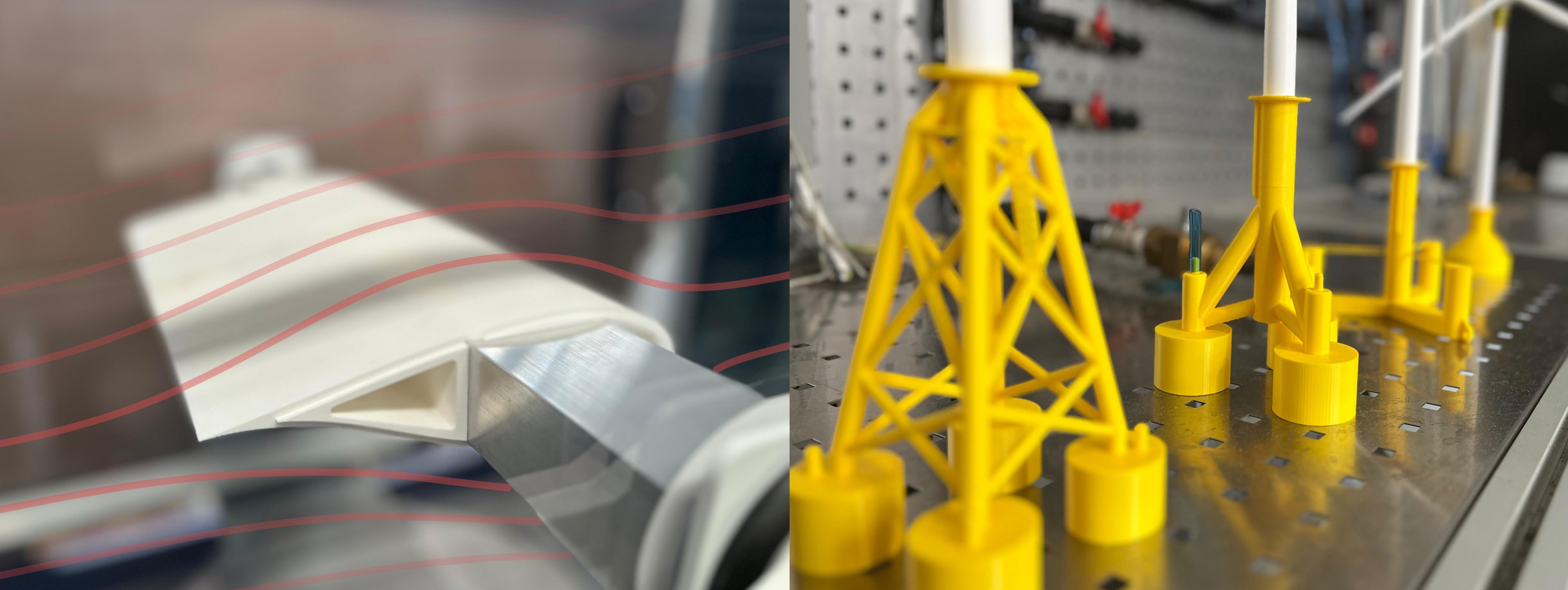
As part of the Blue Economy sYnergies fOr sustaiNable Development (BEYOND) project, Summer School on Offshore Wind Farms – Technical Aspects will be organized at the Faculty of Engineering in Rijeka by members of Computational Engineering Lab.

This Summer School provides an intensive, interdisciplinary introduction to offshore wind farms, combining technical, environmental, and industry perspectives. Through expert lectures and panel discussions, hands-on workshops, computer simulations, wind tunnel demonstrations, and 3D modelling, participants will gain practical insight into the design, operation, and impacts of offshore wind energy systems.

2nd Computational Engineering Seminar

We are pleased to announce our next seminar, which will take place on Wednesday, January 28th, at 13:00 in the Computational Engineering Laboratory (Room L-10).

Two exciting presentations are scheduled:

  • Bojan Crnković – Introduction to CMA-ES
  • Ante Sikirica – Pareto Optimality and NSGA-II

All interested researchers and students are warmly invited to attend. We look forward to your participation!

A paper accepted for publication in IEEE Transaction on Robotics

Happy to share that our paper Probabilistic Modeling and Control for Multi-UAV Search Over Uneven Terrain, by Luka Lanča, Karlo Jakac, and Stefan Ivić, has been accepted for publication in IEEE Transactions on Robotics and is now available on IEEE Xplore.

In this work, we study how multiple UAVs can cooperatively search complex, uneven terrain more effectively. The proposed control framework estimates target detection probability under uncertainty and adapts the search strategy accordingly. The approach combines machine-learning–based detection, ergodic search control, and MPC-based altitude and speed control, while accounting for UAV motion and sensing constraints, detector performance, and terrain features.